Czech summers have grown more irregular over the past two decades. The period from 2015 to 2025 produced several consecutive years of below-average summer rainfall across Bohemia and Moravia — in some years, July and August received less than 40% of historical averages. Garden owners who previously relied on periodic rain for lawn and border watering found the approach inadequate. At the same time, water consumption during dry spells puts pressure on municipal supply systems, raising the case for efficient delivery rather than blanket application.
Rainfall patterns in Czech residential gardens
Annual rainfall across Bohemia and Moravia ranges from 450 mm in the Elbe lowlands to 700–900 mm in highland areas like Jeseníky and Šumava. The distribution matters more than the total: most precipitation falls in May–July, leaving August and September structurally dry. Established lawns need 20–25 mm per week during active growth. In a dry August, that means providing nearly all of that through irrigation.
Evapotranspiration — the combined loss of water from soil and plant surfaces — peaks in June and July in the Czech Republic, often reaching 4–6 mm per day on warm, sunny days. An unirrigated lawn under these conditions will enter dormancy within 10–14 days.
Drip irrigation
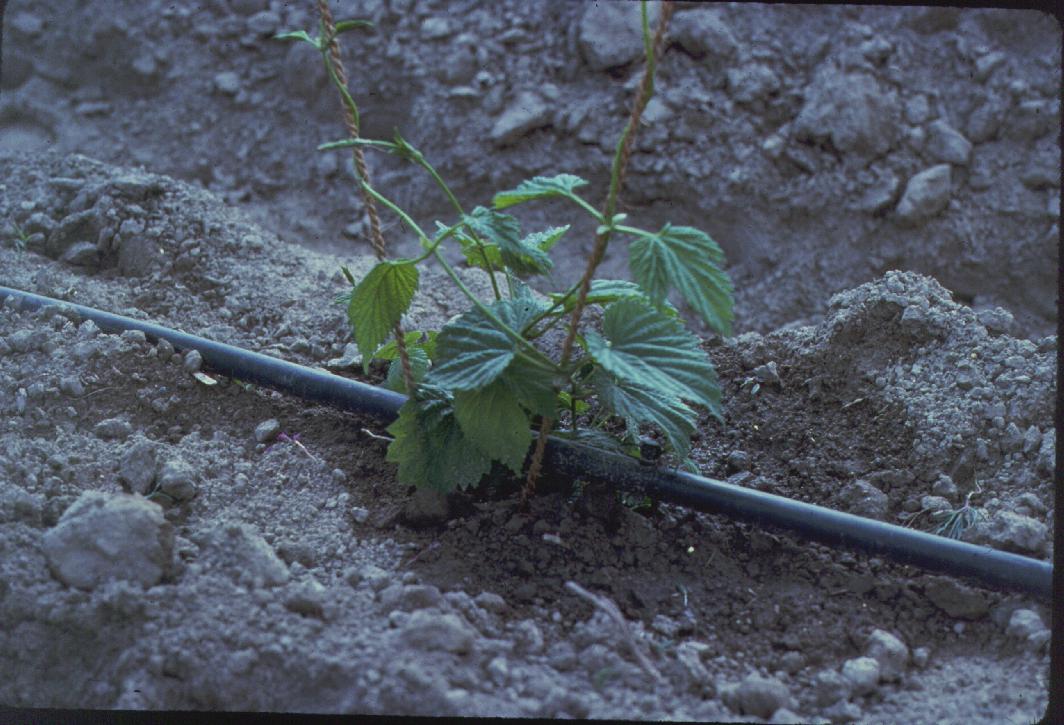
Drip systems deliver water directly to the root zone through emitter tubes, bypassing leaf surfaces entirely. They are the most water-efficient format for vegetable beds, border plantings and young trees or shrubs. Losses from evaporation are minimal because the water is released near ground level at low flow rates.
Installation considerations
Standard drip line for residential use runs 16 mm diameter main tube with 4 mm branch lines terminating in adjustable emitters. For a 20 m² vegetable bed, typical installation involves a 16 mm header running along the bed edge, with branch lines spaced 30–40 cm apart. Emitters are set at 20–40 cm spacing depending on plant density.
Czech mains water pressure runs 2.5–4 bar in most residential areas. Drip systems require pressure reduction to 1.0–1.5 bar — a pressure regulator inline at the tap connection avoids emitter blowouts and uneven flow.
Winter drainage is non-negotiable. Czech frost penetrates 30–60 cm into soil in most regions. Drip lines left filled in October risk splitting. Most systems use a main shutoff with a drainage port — tilting the tubes slightly toward the outlet when installed makes gravity drainage complete.
Oscillating and stationary sprinklers
Sprinklers are appropriate for lawns and large open areas where overhead coverage is more practical than point delivery. The efficiency trade-off is real: a significant fraction of sprinkler-applied water evaporates before reaching the soil, particularly when watering during midday heat. Early morning application — before 9:00, ideally before 7:00 — reduces this loss substantially.
Oscillating sprinklers with rectangular coverage patterns suit the rectangular plots typical of Czech suburban gardens. Coverage radius typically runs 8–12 m, requiring careful overlap calculation to avoid dry strips. Rotary sprinklers are more wind-resistant — the spray stays closer to the ground — which is relevant in exposed Czech upland gardens.
Area matching
Running a single sprinkler across an area it cannot adequately cover in one position is a common error. Under-coverage leads to dry patches; over-pressure at range edges produces large droplets that compact soil surface. Matching sprinkler type to area dimensions prevents both problems.
Timed zones and automatic controllers
A timer-controlled multi-zone system allows different areas — lawn, vegetable bed, ornamental border, containers — to receive different volumes and frequencies. Most residential controllers on the Czech market operate 3–8 zones and connect to standard garden taps via a solenoid valve manifold.
Smart controllers that connect to local weather data can reduce unnecessary watering after rainfall. Given the cost of water in Czech municipalities (typically 80–110 CZK/m³ including wastewater), the payback period on a controller that prevents over-watering is measured in single seasons for active gardens.
Pipe burial for permanent systems
Permanent in-ground systems — buried supply pipes feeding pop-up sprinklers — require burial below the frost line. The standard recommendation for Czech conditions is 40–60 cm, with the deeper end used in highland areas prone to extended hard frosts. Shallower trenching is increasingly discussed given the milder winters of recent years, but represents a risk that could require costly repair.
Rainwater harvesting as supplementary supply
Underground cisterns and above-ground barrels fed from roof downpipes are common across Czech gardens. A 1 000 litre cistern fed from a 50 m² roof section collects roughly 30–35 litres per mm of rainfall — enough to supply a small garden for several dry days. Cistern water requires basic filtering before entering drip or sprinkler systems to prevent emitter blockage.
Czech municipalities generally do not restrict rainwater use for garden irrigation, though local regulations should be checked for any specific prohibitions on storage volume or connection to mains systems.
Maintenance through the season
Drip emitters benefit from inspection at the start and midpoint of the irrigation season. Clay sediment from well water or impure cistern supply blocks emitters gradually. Flushing the main line by briefly removing end caps before closing valves clears accumulated debris. Sprinkler heads in pop-up systems accumulate soil and grass clippings at the retraction point — cleaning once per season maintains spray geometry.

